
San Fermín
Inicio » San Fermín guide » San Fermín
Who was San Fermín?
According to tradition, San Fermín was the son of a Roman senator named Firmo. He was born in Roman Pamplona during the reign of Emperor Diocletian.
Es convertido al cristianismo por San Saturnino de Tolousse.
By the age of 17, he was already preaching the Christian faith. San Fermín traveled to evangelize the Gauls, baptizing 3,000 people in just 40 days.
In the city of Amiens, he became a martyr, persecuted by the local governor. He was buried there after his death.

The First Christians of Pamplona
Tradition tells us that the priest Honestos arrived in Pompaelo (ancient Pamplona) in the mid-3rd century A.D.
Seeing the large number of people open to conversion, he called upon his superior, Saint Saturninus of Toulouse. Saint Saturninus baptized those who wished to embrace Christianity, including Senator Firmo, his wife Eugenia, and their children Fausto, Eusebia, and Fermín.
The chosen location for the baptisms was a well next to the Temple of Diana, which was subsequently destroyed, and the surrounding sacred grove was cleared. The city’s first Christian church was built on this site.
Although no Roman archaeological remains of this temple have been found, the oldest Christian temples in Pamplona seem to lie beneath the current Pamplona Cathedral.
San Fermín, First Bishop of Pamplona
The Diocese of Pamplona is also known as the Diocese of San Fermín, as he is considered the city’s first bishop. Tradition states that he was ordained as bishop by Saints Honesto and Honorato at the age of 24.
At 30, San Fermín left Roman Pamplona to continue evangelizing in the Gauls.
According to tradition, San Fermín arrived in Amiens on October 10. He evangelized for nearly a year until September 25, 303, when he was martyred.
During a period of Christian persecution, San Fermín’s missionary work led to his arrest and eventual execution. He was beheaded, and his body was left abandoned.
The Worship of San Fermín in Pamplona
The devotion to San Fermín began in Amiens during the Middle Ages, where he is still the city’s patron saint.
In the 11th and 12th centuries, people from Amiens traveled to Pamplona and shared the story of this saint, who was born in Pamplona during Roman times.
In 1186, Bishop Pedro de París brought relics of San Fermín to Pamplona, initiating the saint’s veneration throughout the city and the Kingdom of Navarra.
This marked the beginning of the San Fermín celebrations, though they were quite different from the festival we know today.
Co-Patrons of Navarra
In the 17th century, Navarra needed to choose a patron saint. This led to a heated division between supporters of Saint Francis Xavier (Javieristas) and those of San Fermín (Ferministas).

San Francisco Javier
A Navarrese saint born in Javier in 1506, backed by the Kingdom’s Cortes.
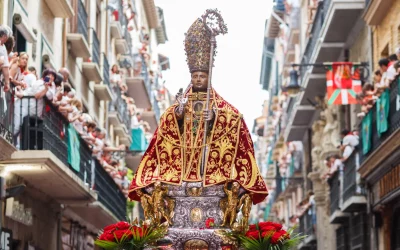
San Fermín
Born in Pamplona, he was the city’s preferred candidate.
The conflict grew so intense that the Pope had to intervene. He decreed that both saints would share the role of Patron Saints of Navarra.
For your information, Pamplona’s patron saint is Saint Saturninus of Toulouse.
The Chapel of San Fermín
Located in the Church of San Lorenzo, the Chapel of San Fermín houses the reliquary bust of the saint. Every July 7, the relic is taken in procession through the streets of Pamplona.
This chapel is one of the most special places in Pamplona and a site of great devotion for those who revere San Fermín. The bust contains the relics brought from France during the Middle Ages.
